
WELLINGTON – India declared on 720 for nine and Jasprit Bumrah removed Tom Latham with the second ball of New Zealand’s second innings on day four of the first Test. New Zealand reached tea on Sunday, 22 November at 33 for one, still 319 runs behind. Henry Nicholls was unbeaten on 21 and Devon Conway on 12 at the interval. The BCCI scorecard subsequently showed 40 for one after 13.2 overs, a deficit of 312, in the live snapshot checked for this report at 10.15 WIB. The Test was still in progress.
Rishabh Pant made 128 and Dhruv Jurel 78 as India turned their overnight lead of 118 into an eventual first-innings advantage of 352. The total is India’s highest in a Test innings in New Zealand. Yet the important change on Sunday came when India stopped batting: after controlling how fast the lead grew, they could start using the time they had left to take wickets.
India turn an overnight lead into something more substantial
India began the fourth day on 486 for four in reply to New Zealand’s 368. KL Rahul’s 136 and Shubman Gill’s 98 had helped build the position on Saturday. India therefore resumed with a lead and six wickets in hand, rather than needing early runs simply to get level. That distinction matters because the batting side could weigh the value of additional runs against the prospect of leaving its bowlers too little time.
The innings already had contributions across the order. Yashasvi Jaiswal made 85 and Devdutt Padikkal 80, giving India runs before Gill and Pant could build on them. Against an opposition that had once been 70 for five in its own first innings, India avoided a similar early collapse. The hands in reserve on Sunday made it easier to pursue runs without depending on a single batter to protect the innings.
Pant supplied the clearest acceleration. He reached his ninth Test hundred with a six over long-off, then hit two more sixes before being caught at the boundary from Rachin Ravindra’s bowling for 128. Pant did not need to bat to the end to make that contribution decisive to the shape of the innings. His runs made the lead large enough that India could keep attacking even as New Zealand began removing batters.
Why the declaration mattered more than the round number
Jurel continued the work after Pant’s dismissal and made 78, becoming the sixth Indian batter to pass fifty in the innings. Glenn Phillips eventually had him caught in the deep and finished with three wickets for 154. India closed the innings immediately after Jurel fell. The declaration left one wicket unused rather than waiting for the final pair either to add runs or be dismissed.
India’s previous highest Test innings total in New Zealand was 520 all out at Hamilton in 2009. In Wellington they went 200 runs beyond it. That comparison describes the scale of the innings, but what mattered more in the match was the difference between the teams’ totals. The 352-run advantage meant New Zealand would have to score another 352 simply to draw level on the first-innings deficit, before anything they added could become a fourth-innings chase for India.
That explains why the choice was not simply between batting on and giving New Zealand a chance to score. New Zealand were going to need another innings unless time ran out. By closing their innings during the fourth afternoon, India gave their bowlers a start before tea, while the hosts still needed hundreds of runs to erase the deficit. An extra partnership would have enlarged the lead, but it would also have used up deliveries India could otherwise bowl. That trade-off is central to a declaration in a five-day match.
Bumrah repeats his first-innings breakthrough
India’s first chance with the ball arrived almost immediately. Latham edged behind on the second delivery of the innings and departed without scoring for the second time in the Test. Bumrah had removed him from the third ball of the first innings. That gave India an early wicket with the new ball on both occasions, rather than having to wait for the pitch or the score to force the opening pair into a mistake.
It also brought Nicholls back to the middle. His 175 in the first innings had helped New Zealand recover from 70 for five, with Phillips also reaching a century. The past recovery gives the hosts a concrete example of what sustained batting can achieve in this match. It does not guarantee a repeat. The second innings opened under a much larger scoreboard burden and with less time remaining than the first.
Nicholls and Conway took New Zealand through to tea without another wicket. At tea, the difference between their second-innings total and the remaining deficit was substantial, but so was the distinction between runs and wickets. India had removed only one of the ten batters they would ordinarily need to dismiss to complete a second innings. For the batting side, a session spent losing relatively few wickets can protect the chance of surviving the match, even if runs accumulate too slowly to erase the deficit during that session.
What to watch from the tea interval
The next phase was about whether New Zealand could extend the partnership beyond the initial burst with the new ball. As the ball ages, a batter may get more time to judge which deliveries can be left alone and which offer scoring chances. That is a possibility, not an automatic effect. India still had the fielding flexibility provided by a large lead and could choose to keep catching positions in play rather than protecting every easy single.
The relationship between the batters’ scores also matters less than the work they do together. Nicholls and Conway had both contributed at tea. Neither needed to score at a predetermined rate to keep a draw possible. If one batter falls, however, the next player must quickly make similar judgements about length and movement, often with fielders close enough to take an edge. For India, one wicket can therefore create a fresh chance to take another, even when the scoreboard has moved little in between.
Nothing at tea settled the match. India had the larger total, the time gained by declaring and a first wicket. New Zealand still had nine wickets in hand and an established pair at the crease. The arithmetic measures the distance between the teams, but the match will turn on whether India can convert that advantage into wickets before the available time runs out.
Reporting cutoff: Sunday, 22 November 2026, 10.15 Western Indonesian Time (WIB).
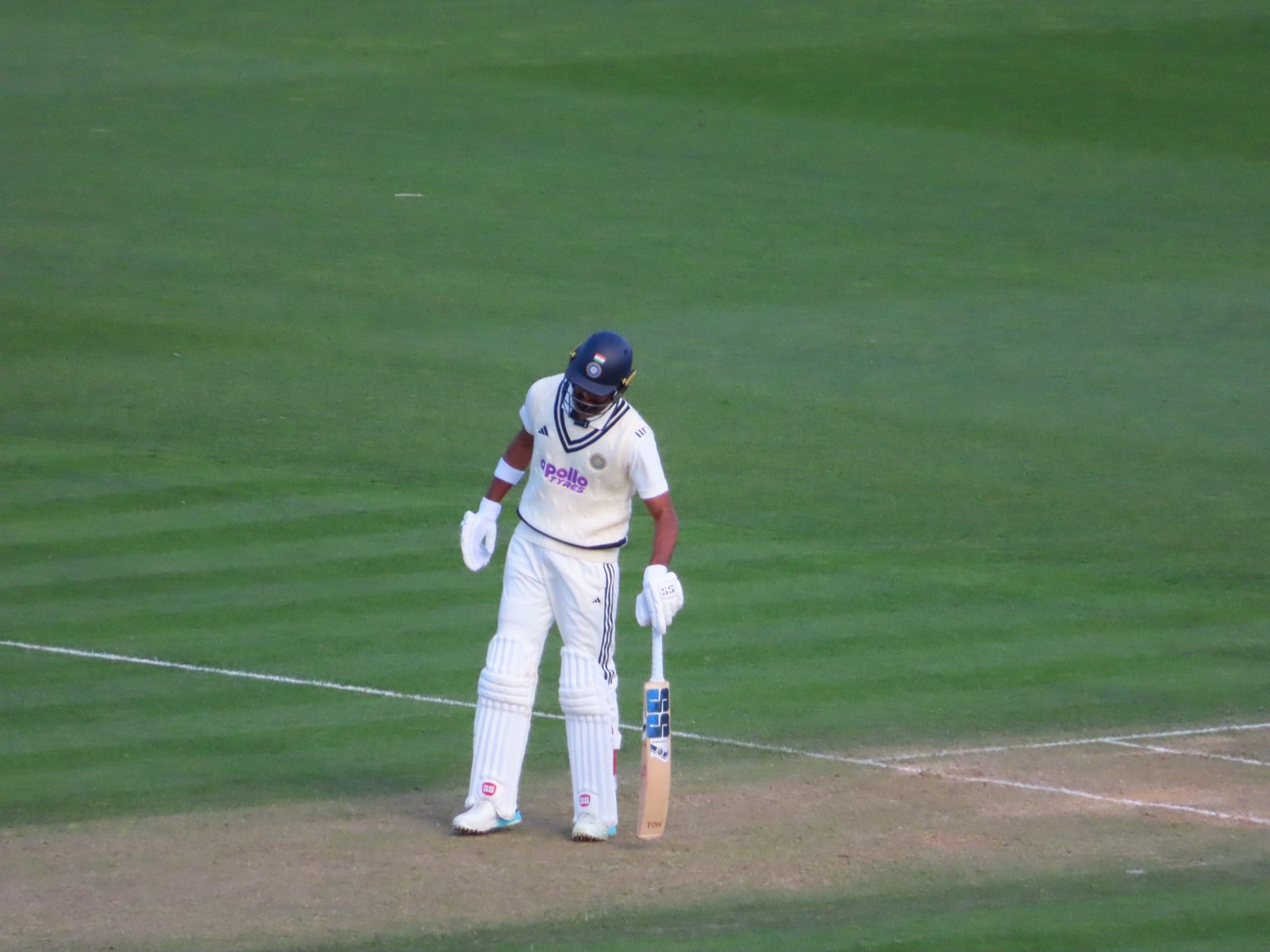
Photograph: Devdutt Padikkal batting on day two of the same first Test at the Basin Reserve, Wellington, 20 November 2026. The photo does not show day-four play. JaumeBG / Wikimedia Commons. File: https://commons.wikimedia.org/wiki/File:New_Zealand_v_India,_1st_Test_(November_2026)_%E2%80%93_25.jpg. Licence CC BY-SA 4.0: https://creativecommons.org/licenses/by-sa/4.0/. WordPress may resize the display copy.