James Quattlebaum and Tristin Van Ord led from the first recorded checkpoint to win the professional races at the Philadelphia Half Marathon on Saturday, 21 November 2026. Quattlebaum finished 12 seconds clear of Haftu Knight on the race-day professional leaderboard, while Van Ord was more than four and a half minutes ahead of the next woman in the professional field. The two races took the same route through Philadelphia, but the gaps they produced told quite different stories.
The race-day professional board listed Quattlebaum at 1:01:53 and Van Ord at 1:14:02. The public results from the event's timing provider also put them first in the men's and women's tables, at 1:01:52 and 1:13:59 respectively. Those tables combine runners who appear in separate professional and open categories on the race-day board. The figures below identify which table they come from rather than treating the two sets of times and placings as interchangeable.
Quattlebaum keeps Knight and Gedamu at a distance
Quattlebaum reached the 4.3 km checkpoint in 12:35, already 13 seconds ahead of his nearest challenger. His lead was 18 seconds at 10 km, which he passed in 29:06. At 15 km he had run 43:54 and was still 17 seconds in front. The lead narrowed by the finish, but no runner in the chase group got close enough to threaten his position on the published splits.
It was behind Quattlebaum that the order changed. Knight and Gary Martin were both recorded at 29:24 through 10 km. At 15 km, they again had the same recorded time, 44:11, with Martin listed second at the checkpoint. Knight ended up second at the finish in 1:02:05 on the professional board. Getinet Mele Gedamu took third in 1:02:15, ahead of Martin in 1:02:23. Jack O’Farrell was fifth in 1:04:48.
The second, third and fourth runners finished within 18 seconds of one another. Quattlebaum had no change of leader to contend with at the checkpoints; the chase was less settled even with only 12 seconds between first and second at the finish. The split data cannot show every move between mats, but it does show that being second at 15 km was no guarantee of a podium place. Martin did not hold that position, while Gedamu ended up ahead of him at the line.
Quattlebaum's professional time works out to roughly 2 minutes 56 seconds per kilometre over the standard half-marathon distance. His 10 km split was slightly faster than that average, and the pursuers did take back a few seconds in the closing stretch. They simply had too much ground to recover.
Van Ord stretches her lead past four minutes
By the first measured split, Van Ord was 58 seconds ahead of the next professional woman. She reached 4.3 km in 15:11, passed 10 km in 34:55 and went through 15 km in 52:37. Her advantage was 2:16 at 10 km and 3:06 at 15 km, before growing to 4:38 over Madeline Heintz at the finish.
Heintz finished in 1:18:40 on the professional board, followed by Alyssa Condell in 1:19:01 and Mackenzie Greenfield in 1:19:27. Whereas Van Ord was adding to her advantage at every published intermediate checkpoint, just 47 seconds separated those three athletes at the finish. The winner's average was about 3 minutes 31 seconds per kilometre.
The difference between the professional and public tables is particularly visible behind Van Ord. Heintz was second among the professional women, but is sixth in the overall women's table published by MyChipTime. That table has Dakotah Popehn second in 1:16:41 and Ellyn Atkinson third in 1:16:52. Popehn and Atkinson competed in the separate open category on the race-day board, where Popehn's winning mark was listed as 1:16:42. Neither table should be read as a correction of the other's category placings.
What the clocks and categories show
The organiser's published rules distinguish gun time, which starts at the official signal, from chip time, which starts when the athlete crosses the start mat. Gun time determines the open prize awards, while chip time is used for age-group awards. MyChipTime's detailed search has separate columns for gun and chip times, but its public leaderboard labels the single value beside each name only as ‘Time’. The small differences between that table and the race-day professional figures should not be assigned a cause from those leaderboard pages alone. Both sources agree on the winners, and the organiser says race-day results remain provisional until validated. The published course marks offer a separate comparison: Mohammed El Youssfi ran 1:01:45 in 2025, and Vicoty Chepngeno ran 1:09:09 in 2021. Quattlebaum came within eight seconds of the men's mark on the race-day clock but did not break it. Van Ord's separation from her rivals was Saturday's standout margin rather than a new course record.
That distinction also matters further down the field. Joe Cardie won the open men's race in 1:07:33 on the race-day board. At 15 km, he and Anthony Gargani both registered 48:01, with Maximilian Hoffman a second behind. Hoffman moved up to second at the finish. In the push-rim wheelchair race, which started separately, Valera ‘Jacob’ Allen finished in 53:43, six seconds ahead of Hermin Garic, according to the race-day results.
A Saturday race across Philadelphia
The half marathon started on Benjamin Franklin Parkway near 22nd Street, with push-rim wheelchair racers due off at 6.55 am and the runners and walkers at 7 am local time. That was 6.55 pm and 7 pm in western Indonesia. The certified course took entrants through central Philadelphia and Old City, across the Schuylkill River towards University City, then through Fairmount Park and back towards the Philadelphia Museum of Art. The course had four published checkpoints, at 4.3 km, 10 km, 15 km and 20 km. On a route this long, a lead that holds at one mat can change before the next. That is why the sequence of gaps, not just the final margin, is instructive in comparing the two races.
The half marathon has been part of the weekend since 2006. It shared Saturday's programme with the Rothman Orthopaedics 8K, with the full marathon and children's run scheduled for Sunday. The organisers expected about 40,000 participants across the weekend's events, not in the half marathon alone.
No single split decides a half marathon. In Philadelphia, the value of the checkpoint data was that it showed where the winners made their margins. Quattlebaum established his advantage early and protected most of it while the chasing places changed hands. Van Ord used the same distance to pull further away. The two finish times marked clear victories, but the route to each was different.
Reporting cutoff: Sunday, 22 November 2026, 13.15 Western Indonesian Time (WIB).
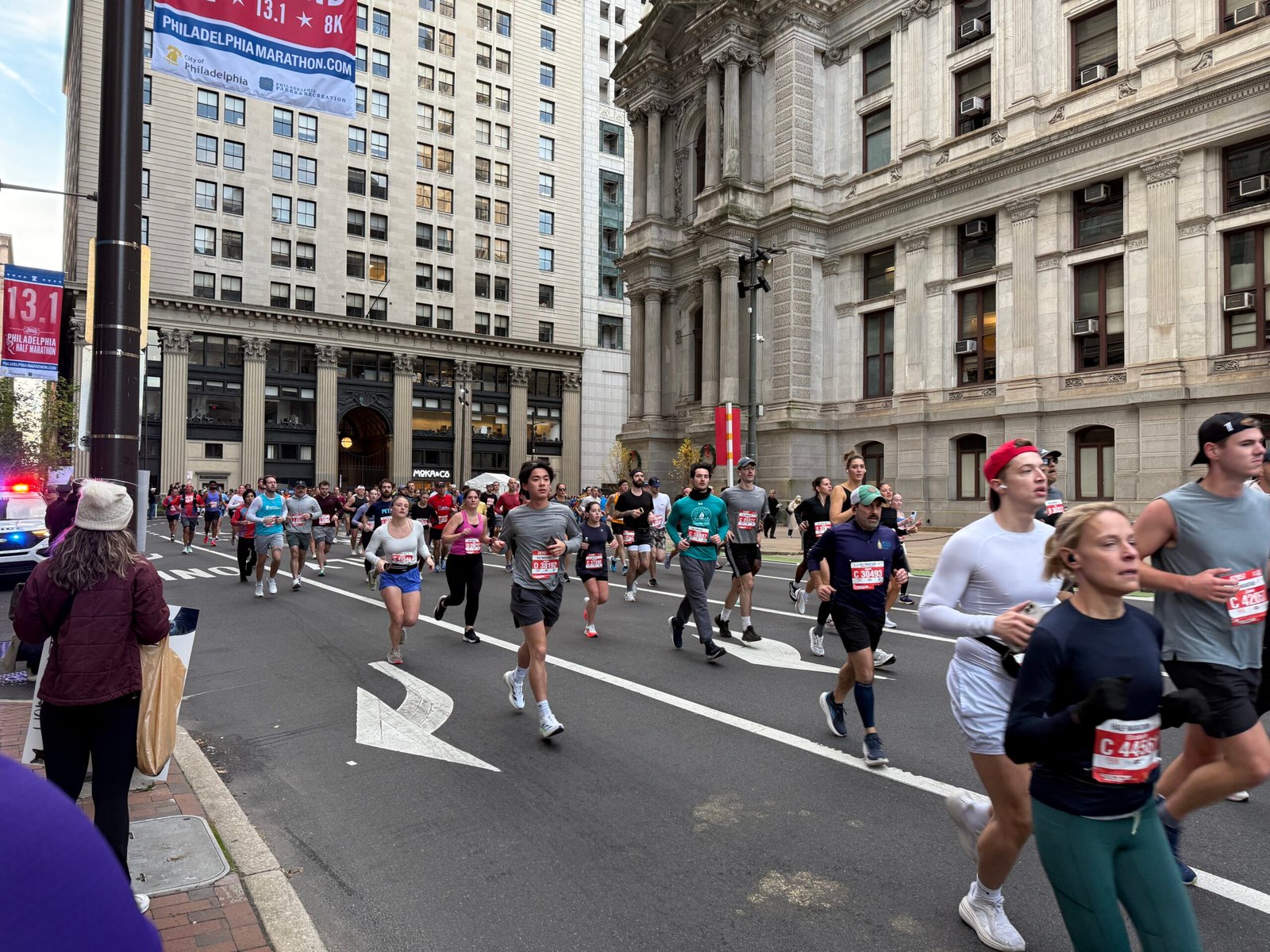
Photograph: Runners on East Penn Square at Market Street during the 21 November 2026 Philadelphia Half Marathon; race scene, not a portrait of the winners. Dough4872 / Wikimedia Commons. File: https://commons.wikimedia.org/w/index.php?oldid=1304572621. Licence CC BY-SA 4.0: https://creativecommons.org/licenses/by-sa/4.0/. WordPress may resize the display copy.