KITCHENER – Andrew Aguanno won the timed three-kilometre race at the Santa Pur-suit in Ontario in 8 minutes 57 seconds on Saturday, 21 November 2026. Run Waterloo said he lowered its own three-kilometre record at the sold-out event, which sent runners in Santa suits down Weber Street from Kitchener to neighbouring Waterloo before the local Christmas parade.
The event combined a chip-timed 3 km race with an untimed 1 km fun run. Run Waterloo reported a sold-out field of 750 across the event, while its results recorded 576 finishing times for the longer distance. Those figures measure different parts of the event. The first describes the scale of the event as reported by the organiser; the second counts only those who appear as timed finishers in the 3 km results.
What Aguanno’s time means
Aguanno’s 8:57 averaged 2:59 per kilometre. Jeremy Hardeman was the next finisher in 9:39, a gap of 42 seconds. The times do not show how the runners paced each kilometre, but they do show how much faster the winner covered the complete distance. For an event spanning just three kilometres, that difference is equivalent to 14 seconds per kilometre on average.
The organiser’s previous distance record was 9:22, also set by Aguanno at the Santa Pur-suit, in 2023. Saturday’s time was 25 seconds quicker. The distinction between a record for Run Waterloo’s races and a wider Canadian or international record matters. Run Waterloo reported a new best in its own results history. That claim does not mean the time is a national road record or that every three-kilometre course can be compared on the same terms.
Official results list several types of performance beyond the overall lead. Matt King’s 9:58 was the leading men’s masters time, while Laura Derksen led the women’s masters classification in 13:29. The results also include separate team classifications, including open and corporate entries. Runners’ Choice Waterloo led the open category and Ditner Construction led the corporate category. These results provide a way to see who excelled within different formats without assuming each participant was trying to match the front of the field.
There was also a useful distinction between the speed at the front and the range behind it. The public table extends to 44:59 and includes a walking classification. Those times do not detract from a fast winning performance. They show that people were able to enter the same timed event with very different goals. A results sheet can recognise a clear winner while also recording a finish for someone who takes a considerably different approach to covering the route.
A road race built around a parade route
The 3 km was scheduled to start at 9.40 am Eastern Standard Time, or 21.40 WIB on Saturday. The starting point was the junction of Weber Street East and Frederick Street in Kitchener. Runners followed Weber Street to the finish at Weber Street North and Erb Street East in Waterloo. The 1 km was scheduled ten minutes later from Weber Street South and Hartwood Avenue, using the final portion of the longer route and the same finish.
The parade was scheduled for 10 am local time, with the route already due to serve a second purpose after the start of the races. The difference between start times matters when considering the format. It was not a race on a separate track beside a parade. It used the street corridor itself, letting people along the route watch a timed community event before the floats and bands. Local coverage by CityNews Kitchener and the Lions Club’s parade information corroborated the broader schedule and route.
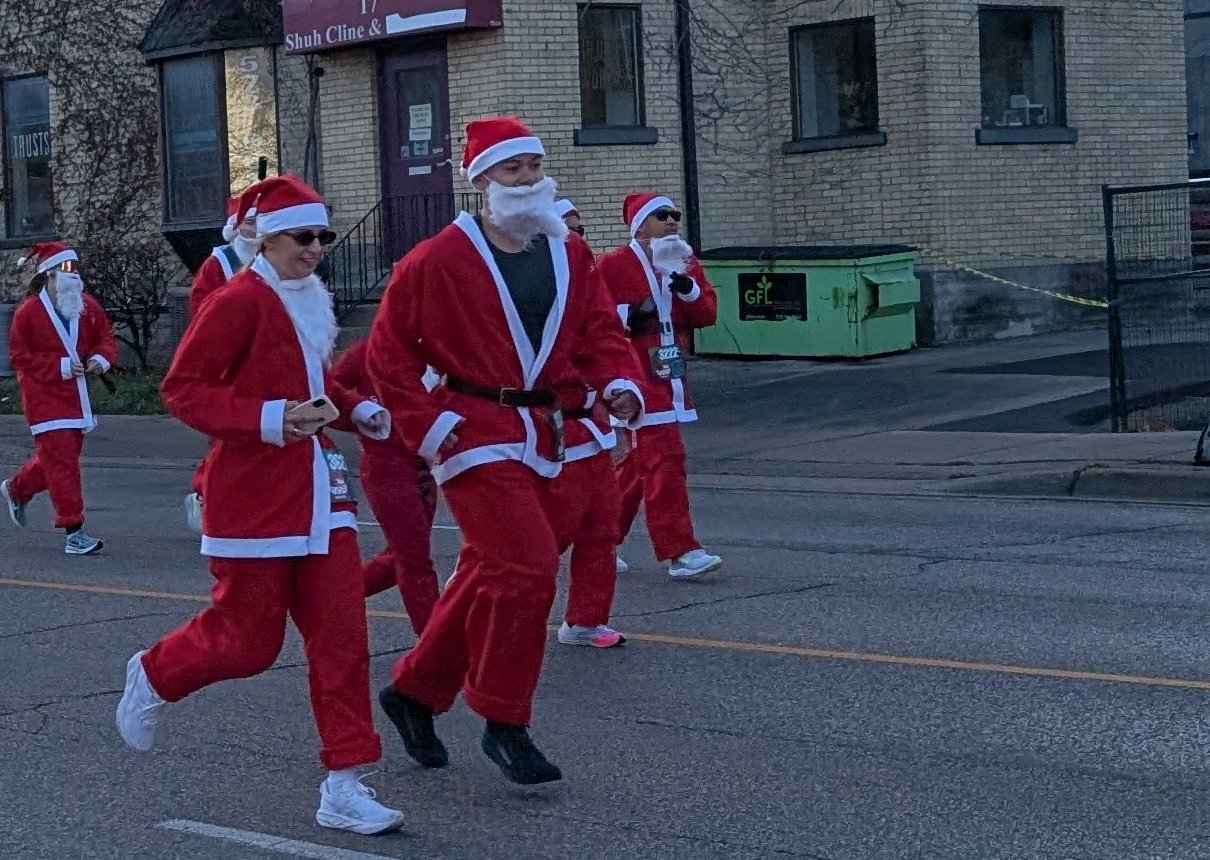
Run Waterloo described this edition as its 13th annual Santa Pur-suit and its last event of the year. The full Santa suit was part of the entrant rules, not simply a suggestion for spectators. The published requirements included a jacket, trousers, hat, beard and belt. Participants who already had a suit from a previous edition could register at a different price, providing a practical way to reuse what the event had already issued.
Matching costumes make the idea visible from the pavement without requiring a spectator to follow the timing system. They do not make the competition anonymous: the timing table still distinguishes results. That separation allows the public experience on Weber Street to feel different from the sporting information available after the finish. For someone watching, it looks like one collective event. For a participant checking their result, it is an individual or team performance.
Timing creates one objective; participation creates another
The contrast between the two distances is one of the event’s clearest design choices. Timing the 3 km gives a runner a position, a pace and a number that can be compared with a previous attempt. Leaving the 1 km untimed allows people to take part without appearing in a ranked table. The arrangement does not make either distance less important. It gives participants two different answers to a basic question: is the main objective to test a time or to complete the route in the company of others?
For other organisers, that choice can be more useful than treating inclusive entry and competitive timing as opposing goals. A shorter, untimed route can preserve part of the experience without copying all of the competitive rules. A timed route can still recognise walking and age-group results alongside fast runners. Where routes share a finish, clearly communicating separate start points and start times is especially important so participants know which part of the course applies to them.
The most revealing numbers from Kitchener are therefore not interchangeable. Aguanno’s 8:57 belongs to a specific distance and a defined record list. The 576 times describe the published finishers at that distance. The sold-out field, reported at 750, describes the event more broadly, including the untimed option. None of those counts measures the number of people who watched from the roadside, which the organiser did not establish in its account.
That distinction is what makes the Santa Pur-suit worth covering as sport rather than only as a parade attraction. A clear finishing order, an organiser’s record and different ways to take part fit into the same morning. The headline result was a sub-nine-minute 3 km, but the shared course allowed the event to serve people who did not come to chase a record. Their participation is part of the story without needing to turn every runner’s time into the same measure of success.
Reporting cutoff: Sunday, 22 November 2026, 11.15 Western Indonesian Time (WIB).
Photograph: Runners on the Santa Pur-suit course in Kitchener, Ontario, on 21 November 2026. Photo cropped from the original; the adaptation is licensed under CC BY-SA 4.0. Hannah Clover / Wikimedia Commons. File: https://commons.wikimedia.org/wiki/File:Santa_Pur-suit_4.jpg. Licence CC BY-SA 4.0: https://creativecommons.org/licenses/by-sa/4.0/. WordPress may resize the display copy.