




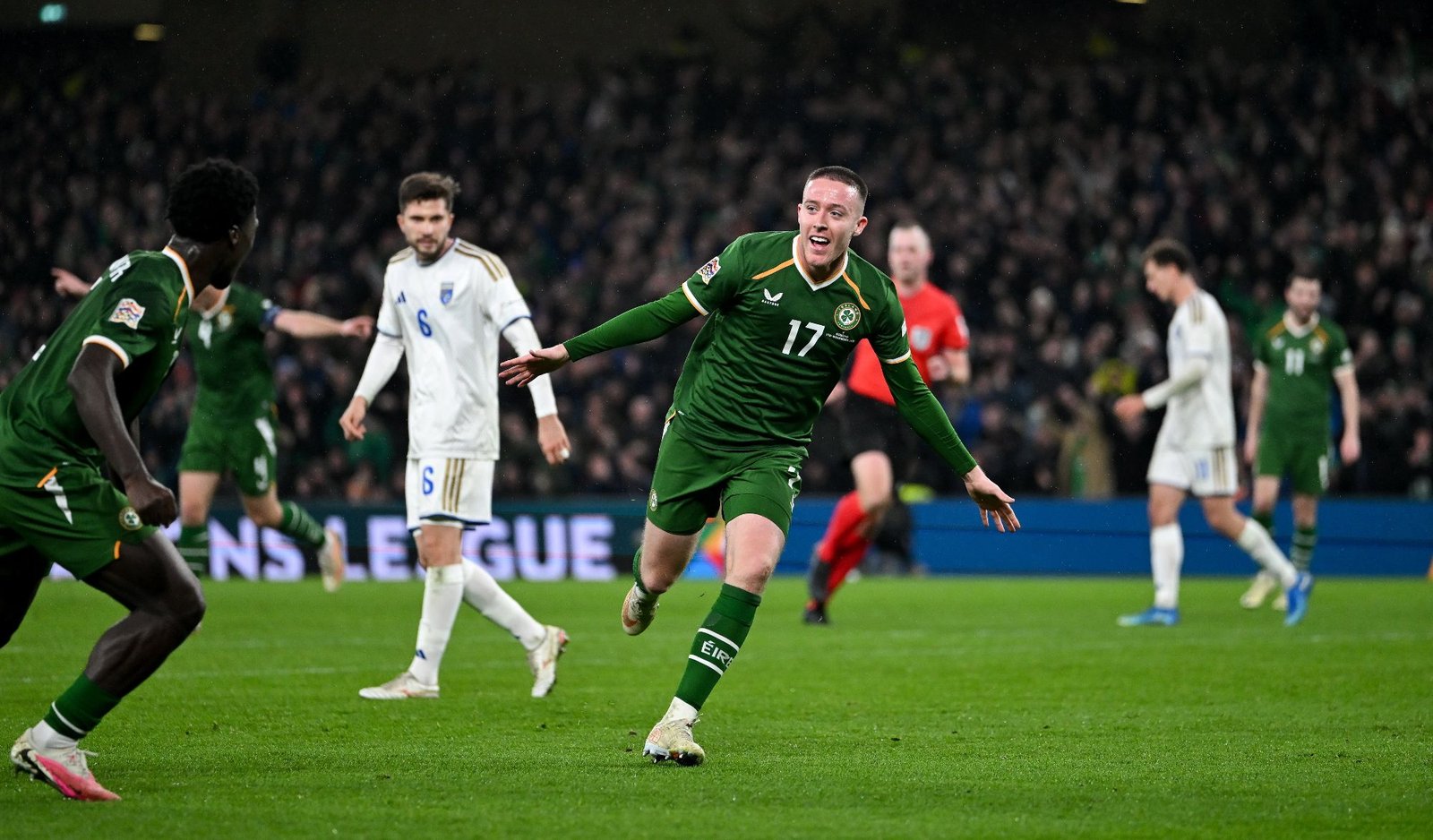
The Republic of Ireland beat Kosovo 3–0 in Dublin to secure a Nations League promotion play-off and improve their position for Euro 2028 qualifying. Troy Parrott converted two penalties and Jack Moylan added the third as Ireland finished second in Group B3, ahead of their final-day opponents. The match began at 19:45 in Dublin on 17 November, equivalent to 02:45 WIB on 18 November.
For readers following the result from Indonesia, the important distinction is straightforward: Ireland have earned another opportunity, not completed either journey. They have not yet won promotion to League A, and they have not qualified for the European Championship. Tuesday’s victory matters because it changes the next steps in two separate competitions, each with its own draw, opponents and qualification rules.
A decisive night, not a finished job
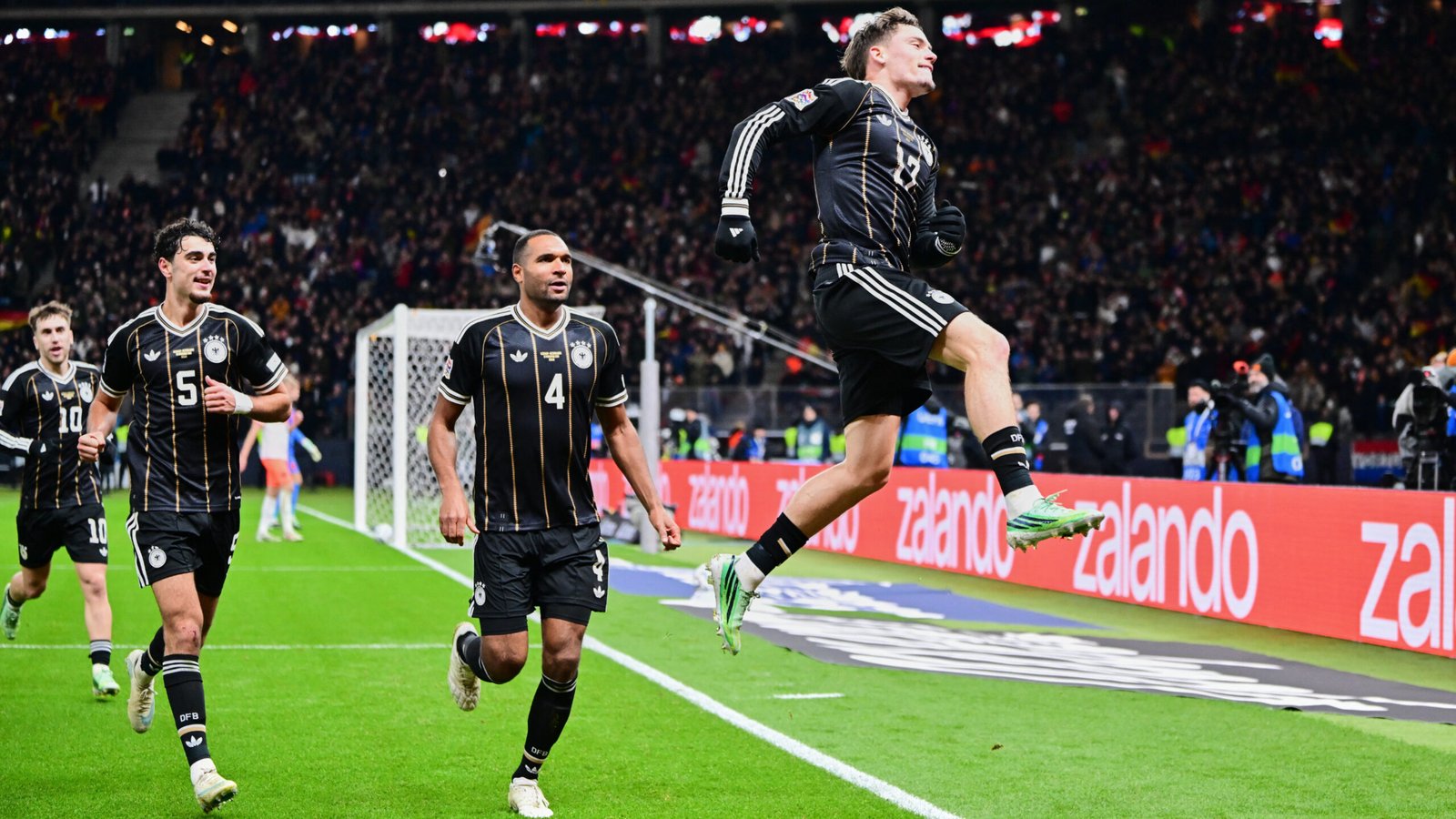
Kosovo were reduced to ten players when Kreshnik Hajrizi was dismissed in the 26th minute for handling a goalbound effort. Parrott converted the resulting penalty before adding another after the interval. Moylan’s 75th-minute goal completed the scoring and gave the home side a clear margin at the final whistle.
The dismissal is essential context when assessing the performance. A three-goal victory against opponents playing much of the evening a man short cannot, on its own, establish how Ireland will cope against a full-strength League A side. Equally, a numerical advantage still has to be converted into goals and a result. Ireland did that on an evening when a draw would not have delivered their objective.
Caoimhín Kelleher also had work to do before the breakthrough, with Kosovo creating early openings. The final score therefore should not obscure the competitive opening or suggest that the visitors were harmless throughout. Ireland’s clean sheet and finishing ultimately turned an initially uncertain contest into a convincing result.
Why second place was the target
Ireland entered the evening knowing that victory would secure the runners-up position. Their previous match had brought a 1–0 defeat away to Austria, leaving this final fixture as a direct opportunity to change their standing. John Egan replaced the injured Nathan Collins in the starting side, with Dara O’Shea taking the captaincy.
There was a useful contrast with the reverse meeting: Kosovo had won that encounter 1–0. The return match therefore offered more than a chance to collect points; it allowed Ireland to reverse a result that had complicated their campaign. That does not erase the earlier defeat, but it explains why the last fixture carried so much weight.
Before kick-off, Ireland had one win, two draws and two defeats in this Nations League campaign. Adding Tuesday’s victory produces a six-match return of two wins, two draws and two defeats, worth eight points. That arithmetic illustrates an important tournament lesson: a team does not need a flawless group campaign to keep a promotion route open, but must take the opportunities the format leaves available.
What the promotion play-off actually offers
Under the current Nations League structure, League B group winners move up automatically. Runners-up instead enter the League A/B play-offs. Ireland belong to that second group, so the next contest is a test for promotion rather than a celebration of promotion already achieved.
The wider format is also changing. The 2028/29 competition is set to have three leagues of 18 teams, and the present promotion and relegation arrangements have been designed around that transition. In League A, the two highest-ranked third-placed teams stay up. The other two third-placed teams and the two highest-ranked fourth-placed teams enter the A/B play-offs against League B’s four runners-up.
That detail matters when reading older explanations of the competition. It is not safe to assume that every third-placed League A team faces the same outcome, or to identify Ireland’s opponent simply from a familiar version of the rules. Ranking across groups now affects which teams enter the play-off pool. The opponent must come from the confirmed draw, not from an assumption based on a previous edition.
The dates to follow next
The knockout-stage and play-off draw is scheduled for Friday 20 November in Nyon, Switzerland, starting at 12:00 CET. For Indonesian readers, that is 18:00 WIB on the same day. The League A/B promotion and relegation play-offs fall within the 25–30 March 2027 international window.
Those dates separate the immediate administrative step from the next sporting test. The draw will establish the pairing; the March matches will decide the outcome. Until that pairing is confirmed, claims about a particular opponent, travel itinerary or tactical match-up would be premature. Supporters can mark the draw time now without treating an unconfirmed fixture as settled.
Pot two helps, but does not qualify Ireland for Euro 2028
The Kosovo victory also secured Ireland a place in pot two for the forthcoming European Championship qualifying draw. Seeding shapes the draw process, but it does not award points in the matches that follow. A favourable position on paper remains something a team must turn into results on the pitch.
Ireland’s status as a co-host should not be confused with an unconditional finals place either. UEFA’s approved system places England, the Republic of Ireland, Scotland and Wales in qualifying, with the four hosts drawn into separate groups. Twelve groups of four or five teams will supply the 12 group winners and eight best runners-up as direct qualifiers.
Two places are reserved for the best-ranked hosts who do not qualify directly. That is a limited safeguard shared between host nations, not a separate guaranteed ticket for each one. The remaining finals places are determined through play-offs involving eligible qualifying runners-up and non-qualified Nations League group winners. The number of places available through that route depends on how many reserved host places are used.
A useful way to judge the next stage
Ireland’s immediate achievement is therefore best described in three parts: a final-day victory, a promotion opportunity and an improved qualifying draw position. Keeping those separate avoids turning a good night into an exaggerated promise about what comes next.
The next meaningful questions are practical. Who will Ireland draw? How does the squad look when the March window arrives? Can the side produce a similarly effective performance under different match conditions? Those questions cannot be answered by the scoreline alone. They are the tests that will determine whether this result becomes a stepping stone towards sustained progress rather than simply a successful end to the group stage.
Photo: Stephen McCarthy/Sportsfile. Jack Moylan celebrates against Kosovo at the Aviva Stadium on 17 November 2026.