
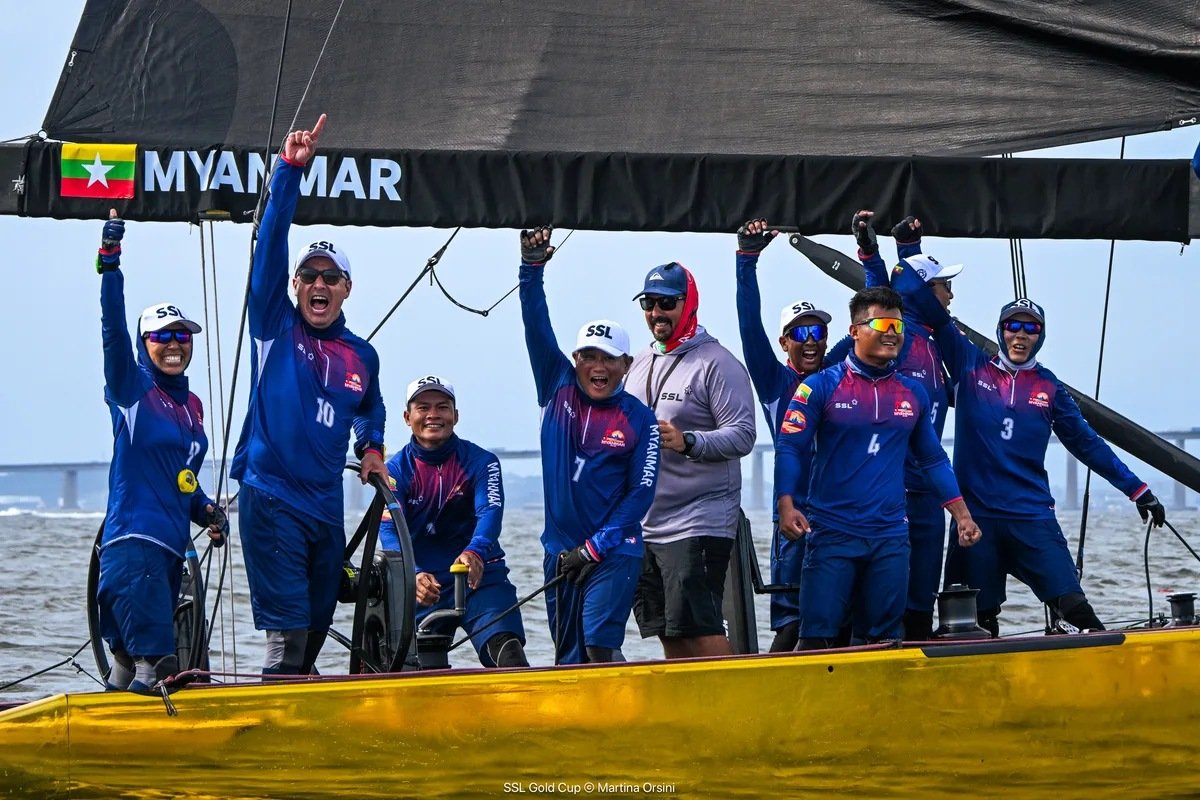
RIO DE JANEIRO. Myanmar and Malaysia reached the next round of the 2026 SSL Gold Cup after winning their respective final races on Guanabara Bay. Myanmar caught Uruguay on the last run to take second in Group D on a tie-break, while Malaysia held off Estonia by four seconds in Group C. Uruguay and Estonia had enough points to win their groups despite losing their closing races.
The fourth and final races took place on Sunday, 22 November, in Rio de Janeiro. On the organiser’s results page, the Group C race is listed at 13.10 local time and the Group D race at 14.40, corresponding to 23.10 WIB on Sunday and 00.40 WIB on Monday. Those are the listed race times, not the finishing times. The race-day schedule published in advance used different slots.
Both winners collected eight points in a format that doubled the value of the last race. That bonus produced two different outcomes. Malaysia’s victory protected a qualifying place it already held before the finale. Myanmar’s win changed the qualifying order, pushing Oman below the cut despite a level points total.
Myanmar finds a way past Uruguay
Oman made the strongest start in Group D. Uruguay came through near the front, and the two crews rounded the first windward mark at the head of the fleet. At that stage, the race favoured the countries already above the qualifying line. Myanmar needed more than a respectable finish if it was to change who advanced.
Oman lost second place to Myanmar on an upwind leg after a problem with a halyard, a line used to raise a sail. Myanmar still had to close on Uruguay. The gap did not disappear in one move: the crews had to work their way through the next crossing before the race opened up again towards the finish.
On the final leg with the wind behind them, Myanmar stayed on the right while Uruguay went left. The two boats were no longer sailing through the same patch of water or relying on the same breeze. A stronger gust helped Myanmar accelerate, and it passed Uruguay with fewer than 100 metres remaining, according to the organiser. Oman finished third and Singapore fourth.
For a reader new to sailing, the distinction between direction and speed is important. A boat that points more directly at the line does not necessarily get there first. Sailing a slightly longer path can pay if the stronger wind more than makes up for the extra distance. But the breeze can fail to arrive, and the other crew can gain while the boats are separated. The outcome in Rio shows what Myanmar gained from the split; it does not make the right-hand side the best choice for the next race.
Malaysia wins the race, Estonia wins the group
Malaysia had beaten Estonia in the third race and started the final day in the second qualifying position. Another win left little to chance. Malaysia gained room early in the final race and rounded the first windward mark ahead, while Estonia had to find clearer air after a crowded start. The two worked their way to the front of the group on the following legs.
Estonia had a different task from Malaysia. Its crew could protect its position against Cuba rather than follow every move of the leader. Upwind, Estonia covered Cuba’s changes of direction, limiting the opportunity for Cuba to take a more favourable strip of breeze. On the last run, Estonia closed on Malaysia, but the margin at the line still favoured the Malaysian crew.
Estonia won Group C with 17 points, followed by Malaysia on 16, Cuba on 11 and Seychelles on six. The race winner earned eight points and second place earned six, so Malaysia gained two on Estonia in the finale. The earlier deficit was three. Put another way, the four-second margin produced a race win, but it could not by itself erase what Estonia had already built in the first three races.
That is also why Estonia did not have to treat every overlap with Malaysia as an emergency. A move that trades a secure second in the race for a chance at first can be attractive on a standalone day. In a fleet where two teams advance across several days, letting one rival go can make sense if keeping the third boat behind preserves qualification. That is a reading of the race situation, rather than a claim that the crew had only one correct option.
How to read the closing races
The top two in each four-boat group advanced. On the last day, first, second, third and fourth scored eight, six, four and two points respectively. Each place was therefore worth twice the usual gap. That matters when the crew being chased finishes farther back: the same race win can close a different gap depending on which boat crosses next.
In Group D, Myanmar gained four points on Oman by finishing first while Oman came third. Uruguay’s second place was sufficient to retain the group lead. Myanmar and Oman were level at the end, but the tie-break sent Myanmar through. Unlike in Group C, the final race did not just narrow the margin between teams; it decided which crew would still be racing next week.
The other qualifying pairs were Portugal and Ukraine from Group A, and Lithuania and Tahiti from Group B. All four group winners and all four runners-up have the same immediate task: they must qualify again in the next phase. Finishing top of a group is not the same as reaching the quarter-finals.
What changes in the next round
Malaysia and Myanmar now join a 16-team phase scheduled for 26–29 November in Rio, alongside the six other teams that advanced and eight crews entering at this stage. The competition uses identical SSL47 yachts, which makes the work of finding clean air, setting sails and reading shifts easier to compare across boats. It does not make the water, wind or starting position identical.
For viewers following from Southeast Asia, the most useful way to watch is to keep the race order and group standings separate. The first tells you which crew is closest to winning that race. The second shows whose next-round place is in danger. In Rio, Estonia gave up the race but not the group; Myanmar could not afford either a quiet finish or a routine third. Those different incentives explain why two winners on the same day approached the final leg with different amounts of risk to take.
Reporting cut-off: Monday, 23 November 2026, 16.22 WIB.
Photo: Martina Orsini / Star Sailors League. The Myanmar crew celebrates after winning the final Group D race of the SSL Gold Cup 1/32 Finals in Rio de Janeiro.