


MELBOURNE, TentangBola.com: Juan Mata has retired from professional football at 38 after an award-winning final season with Melbourne Victory. The Australian club confirmed his retirement on 18 November 2026. The announcement closes a playing career that took him from Valencia to World Cup glory with Spain and European trophies in England, but it does not end his association with Victory.
Mata has committed to taking an ownership interest in the club and chairing its football committee. Those commitments preceded his retirement announcement. The distinction matters: Wednesday's development was the end of his playing career, not the announcement of a new coaching appointment or a promise that he will dictate how the senior side plays.
A final season in which he still mattered
Victory was not simply a stop on a farewell tour. Mata scored five goals in the 2025/26 campaign, helped the club reach the A-League Men Finals Series and won both the Johnny Warren Medal and Victory's own Player of the Season award. He also took the league's playmaker prize and made the players' association's Team of the Season.
The combination is more telling than any one statistic. An individual accolade recognises the player's effect on a season; reaching the Finals Series shows that his contribution was made to a side with something to play for beyond the regular campaign. Neither achievement means Mata was responsible for all of Victory's progress. Together, however, they help explain why the club wanted to retain a relationship after he stopped playing.
He had already decided in September not to continue as a Victory player. Leaving the squad and retiring from football were separate decisions. An athlete can end one contract while remaining open to a different role on the pitch. This time, the club's announcement makes clear that Mata is closing the playing chapter altogether, rather than simply moving on from Melbourne.
It is also worth separating the player from the position. Mata won an award associated with chance creation, but football's playmaking is not reserved for the man behind the striker. Players can help make attacks work by drawing a defender away, waiting for a runner or releasing the ball before a passing lane disappears. An award does not quantify every one of those decisions. It does help explain the kind of contribution Victory will have to replace on the field, even if Mata remains involved elsewhere.
The moments that travelled with him
At Valencia, Mata became part of the side that won the Copa del Rey in 2008. Two years later he was in the Spain squad that secured the country's first men's World Cup. By the time Spain retained the European Championship in 2012, he had moved to Chelsea and won the Champions League. His goal in Spain's 4–0 victory over Italy in the Euro 2012 final was one of the most visible moments of an international career spanning 41 senior appearances.
The two medals can obscure an important difference. Being in a winning World Cup squad and scoring in a European Championship final are distinct achievements. The first reflects a player's place in a group assembled for a tournament; the second is an action in a particular match. In both cases Mata was part of a team with enough quality to leave accomplished attackers outside its first choice eleven. His selections show why assessing a career solely through starts misses some of what national squads require.
At Chelsea he lifted the FA Cup and both major European club trophies of the period, the Champions League and Europa League. He moved to Manchester United in January 2014 and stayed for more than eight years, recording 285 appearances and 51 goals. One of those goals came at Wembley in the 2016 FA Cup final, when he drew United level against Crystal Palace; United went on to win in extra time.
That equaliser deserves more weight in a career assessment than simply counting it as one of 51. It arrived in a match with a trophy at stake and brought his side back into a contest it was losing. By contrast, the appearance total tells a different story: he remained a selection option through changing managers and squads. Neither number replaces the other. One describes the breadth of his service, while the Wembley goal captures the stakes of a single contribution.
Mata later played for Galatasaray and Vissel Kobe before heading to Australia. His A-League spell began with Western Sydney Wanderers, then continued at Victory. The success of his final season gives those years a point of their own rather than treating them only as the distance between leaving Old Trafford and retiring.
A football committee is not a dugout
Victory's continuing relationship with Mata is the practical question left by the announcement. Chairing a football committee is different from picking a team, planning training or making substitutions. An ownership interest is also not the same as a public mandate to make every football decision. The club's announcements establish the broad roles, but they do not settle the bounds of Mata's influence over recruitment or the first team.
That is where the next assessment belongs. The playing career is now complete and can be judged on things that happened. His value in football governance will instead depend on how the club defines the job, which decisions are taken collectively, and what results follow. Experience in dressing rooms across leagues and countries can inform those conversations, but it is not in itself evidence that a particular recruitment or development policy will work.
The distinction offers a lesson for other clubs considering how to involve former players. Keeping experience inside a club can make sense without assuming it belongs on the touchline. The useful questions are what problem the appointment is intended to solve, who has authority to act, and how the club will judge progress. Those questions are more revealing than whether a familiar name appears on the organisation chart.
Mata's involvement in Common Goal already gave his career a dimension beyond his match record. He co-founded the initiative while a United player, encouraging people in football to pledge a share of their income to social causes. That is a separate part of his work from his position at Victory and is not evidence of what he will do there. It does show why retiring as a player does not necessarily mean stepping away from the game.
The immediate facts are narrower than the legacy. Mata is no longer a professional player; his last season ended with major individual recognition in Australia; and Victory expects his association with the club to continue off the pitch. What that association achieves is the next story, not a conclusion that can be drawn from the trophies he has already won.
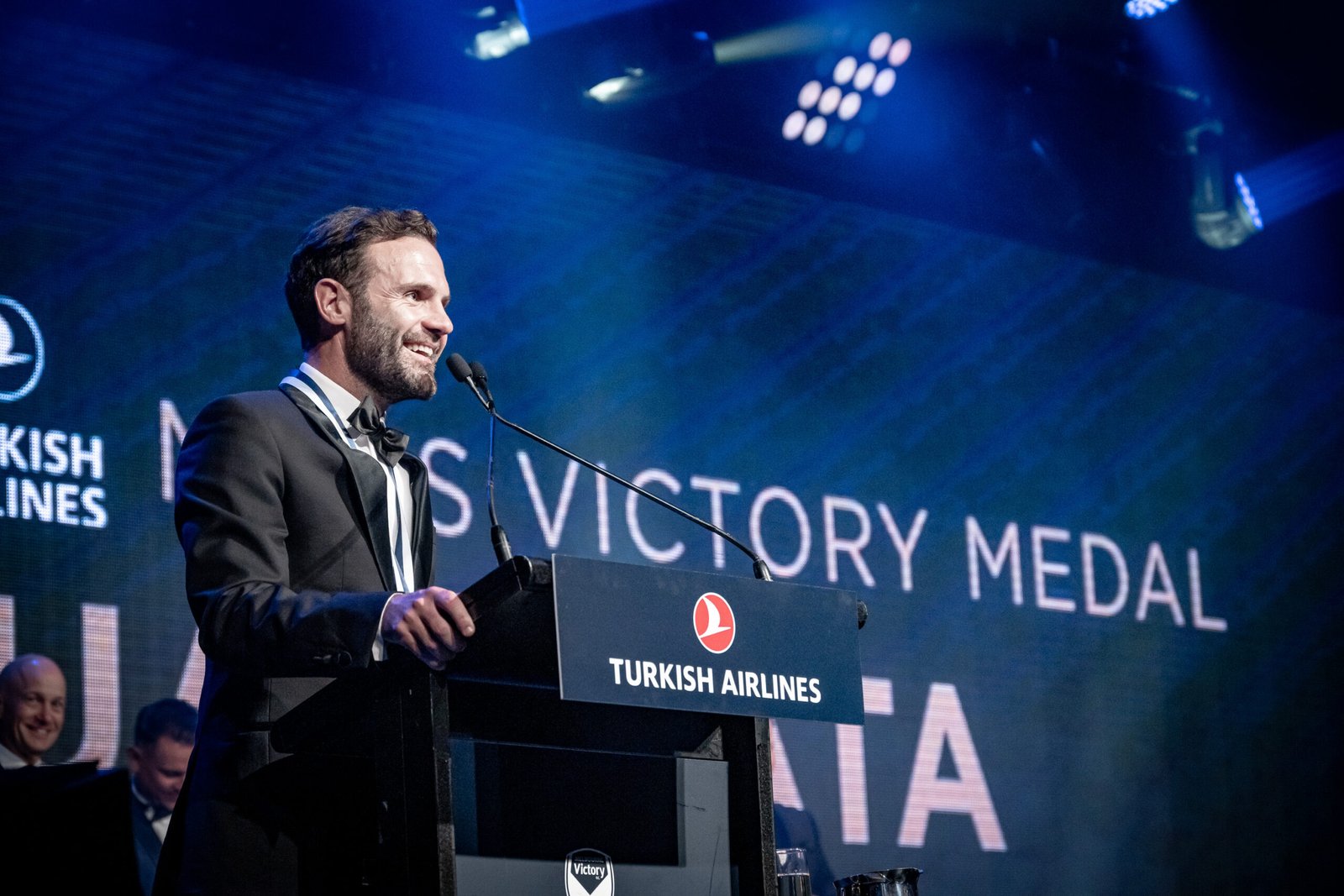
Archive: Juan Mata at the Victory Medal ceremony, May 2026. Photo: Anita Milas/Melbourne Victory.