
Dalam artikel ini
BOLOGNA — Spain reached the Davis Cup semi-finals by defeating Austria 2–0 in Bologna on Thursday, 26 November. Daniel Mérida and Rafael Jódar supplied the two singles victories, meaning Carlos Alcaraz was not needed in doubles. David Ferrer’s team will next face Great Britain on Saturday, 28 November, with a place in the final at stake.
The Spanish tennis federation’s official report records Mérida’s 6–4, 6–4 win over Joel Schwärzler. Jódar then recovered from losing the opening set to beat Jurij Rodionov 2–6, 6–0, 6–1. Alcaraz had been selected alongside Marcel Granollers for a possible deciding doubles match, but Spain’s success in the first two rubbers made that match unnecessary.
Mérida delivers the opening point
Mérida was entrusted with opening the tie for Spain. Speaking to the federation, he described the pressure of representing his country as different from competing for himself. The Madrid player felt nervous early on, then gained control and completed both sets by the same score. His victory allowed Jódar to play for qualification, rather than begin the second singles match with Spain already facing elimination.
The assignment built on Mérida’s experience in the September qualifier against Chile. In its preview of the selected players, the Spanish federation recalled his successful Davis Cup debut, when he came from behind to defeat Alejandro Tabilo. His season also included a first ATP title in Umag and another final in Bucharest, giving Ferrer results to consider when choosing the singles line-up.
That experience provided context for the captain’s decision without guaranteeing the outcome in Bologna. Schwärzler was a 20-year-old left-hander making his Davis Cup debut and had qualified for the Next Gen Finals. Mérida still had to earn a new victory on court. A 6–4 score in each set shows a final margin of two games; the available report does not establish every serving pattern or exchange that produced those margins.
Jódar transforms the match after a difficult start
Spain’s 1–0 lead did not make Jódar’s task straightforward. Rodionov won the opening set 6–2 and created an opportunity for Austria to level the overall tie. Jódar answered with two very different sets, winning 6–0 and 6–1. The federation reported that he put together seven consecutive games while turning the contest around.
Afterwards, Jódar said the Austrian players were comfortable with the playing surface and had clear plans for their respective opponents. He changed aspects of his game at the start of the second set, felt more comfortable and became more solid. His explanation describes an adjustment without identifying one specific technical change. It therefore does not support attributing the entire recovery to a particular stroke or a single attacking pattern.
Across the final two sets, Jódar won 12 of the 13 games played. That figure is calculated from the official 6–0 and 6–1 scores; it is not an additional statistic about individual points or rallies. It illustrates the size of the turnaround after the first set. Rodionov had been one set away from forcing a doubles decider, but Austria ultimately had no opportunity to play that deciding rubber.
Alcaraz was held for doubles and then spared the match
Alcaraz’s role as a doubles option had been announced before the tie began. The Spanish federation linked the decision to discomfort in his left thigh during the previous week’s ATP Finals in Turin. Ferrer selected Mérida and Jódar for singles, with Alcaraz and Granollers available if the teams reached the doubles level at one point each.
Neil Oberleitner and Lucas Miedler were the Austrian pair named for that possibility. Jódar’s victory meant they never faced Alcaraz and Granollers. The absence of a doubles match simply reflects that the tie had already been decided by the singles results. It was neither a doubles defeat for Austria nor an additional victory for Spain: the final team score remained 2–0.
The federation said Alcaraz had avoided further time on court and could continue his recovery ahead of the semi-final. That is separate from any confirmation that he will definitely play on Saturday. The next line-up remains a matter for the captain’s selection. Alcaraz’s Turin campaign had included the ATP Finals semi-final win over Ben Shelton covered by TentangBola in Indonesian before he joined the national team’s preparations.
Two different victories demonstrate the available routes
Spain’s two singles players contributed in different ways. Mérida completed his match without losing a set; Jódar had to recover from a deficit. Each performance produced the same reward for the country: one point. In this format, squad depth means having more than one route towards the required two victories, rather than simply assembling a list of prominent names.
Their different routes also matter when considering the semi-final. Mérida played two sets and Jódar three, but set totals alone do not fully describe either player’s physical condition. Match duration, rally length and the support team’s assessments are not all available in the reports reviewed. The scoreboard by itself cannot establish that one player must be fresher or definitely needs to be rested for the next tie.
Austria reached the Final 8 for a second successive year after winning two qualifying ties. The Spanish federation recorded a 3–2 away victory over Japan, followed by a 3–1 home win against Belgium in September. That route shows Austria had already succeeded in team competition before meeting Spain. The 2–0 defeat in Bologna does not erase those earlier results, but qualification wins cannot replace the need to earn two fresh points at the knockout stage. Each tie starts level again.
Ferrer’s final campaign extends into the last four
Qualification prolongs Ferrer’s final campaign as Spain’s captain. In an interview published by the federation on 24 November, he said he would finish his captaincy after this year’s Final 8. Ferrer explained his wish to return to coaching on the tour and the difficulty of combining that work with his responsibilities as national team captain.
The interview also emphasised the importance of the team environment and the development of younger players. Mérida and Jódar’s victories give that theme a practical expression: the two players entrusted with singles took Spain into the next round. The result has significance for the departing captain, but a quarter-final win remains distinct from winning the competition. Spain still need to win two more ties to lift the trophy.
Great Britain await on Saturday
Spain’s next opponents took a longer route through their quarter-final. Great Britain beat Germany 2–1 through Cameron Norrie’s singles victory and the doubles success of Henry Patten and Neal Skupski. TentangBola’s report on Britain’s progress details that sequence. Alexander Zverev’s win over Arthur Fery had restored parity before the doubles settled which team would advance.
The Spanish federation lists the semi-final for Saturday, 28 November, at 12.00 in Bologna. That agrees with the 11.00 GMT start stated in the LTA’s report, equivalent to 18.00 in western Indonesia. The timing of later matches can depend on how long earlier matches last, so spectators should follow the organisers’ announcements on the day.
Britain are also playing their final campaign under captain Leon Smith, whose departure was announced by the LTA on 20 November. Both teams therefore carry a farewell narrative into the semi-final, while the result still depends on the players’ performances. Spain’s established starting point is the work Mérida and Jódar completed against Austria. Choosing the next line-up and responding to Britain’s singles and doubles strengths are the tasks that follow.
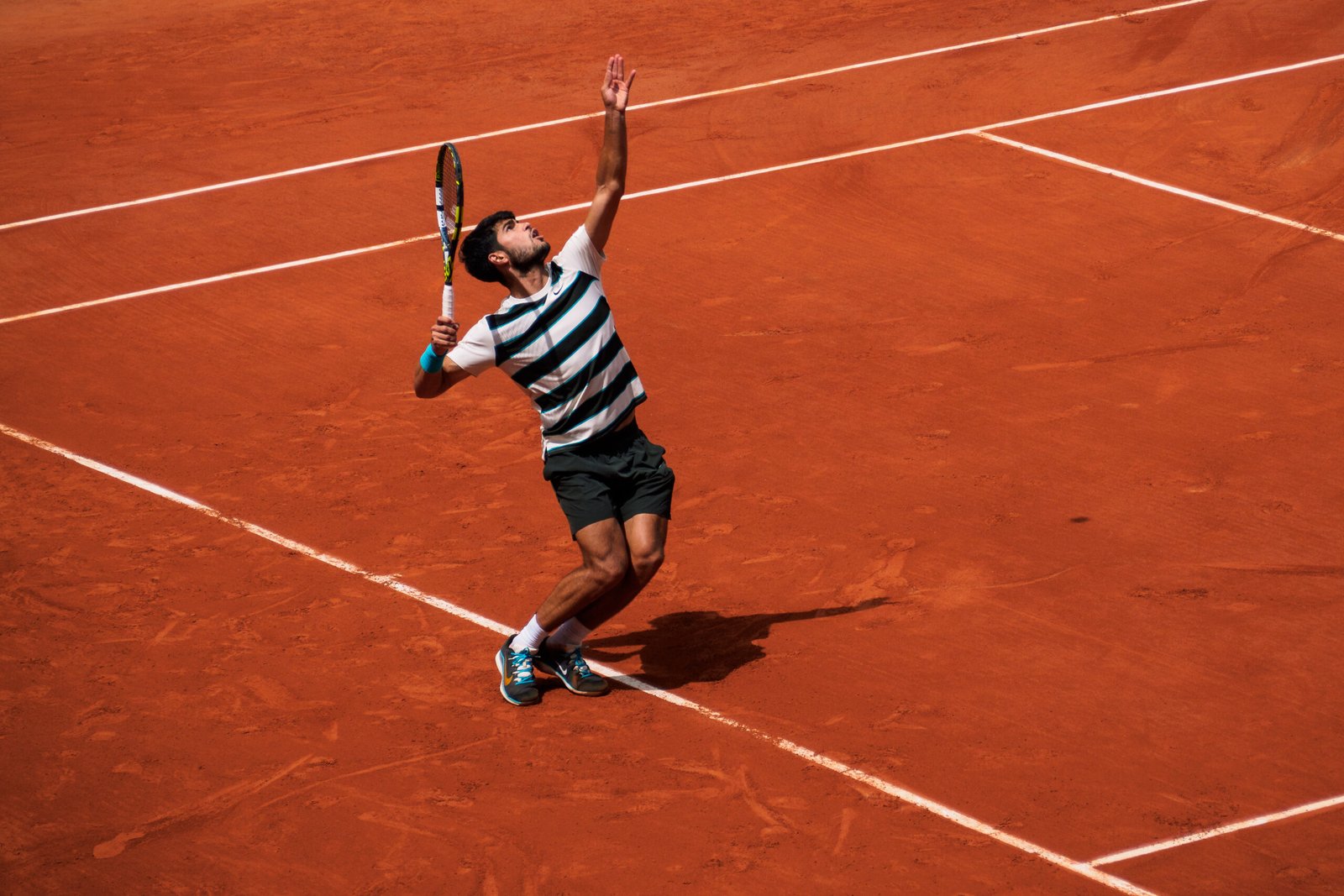
Archive photograph: Carlos Alcaraz serving against Giulio Zeppieri at Roland Garros on 26 May 2025, not the Spain–Austria tie in Bologna. Photo: Martin Terrien (Kuberzog) / Wikimedia Commons, CC BY-SA 4.0. WordPress has resized the image; the photograph remains under CC BY-SA 4.0.