
LONDON – Noah Okafor scored twice as Leeds United came from behind to beat Chelsea 4–1 at Stamford Bridge on Saturday, 21 November 2026. Emmanuel Emegha put Chelsea ahead on his first start for the club, but Okafor equalised three minutes later and restored daylight between the sides after Dominic Calvert-Lewin’s penalty. Brenden Aaronson completed the scoring in stoppage time.
The Premier League match kicked off at 15.00 GMT, or 22.00 WIB, with 39,573 in attendance. Chelsea led for only a brief period and the teams went into half-time level. Leeds then changed the match in the space of five minutes after the restart: Calvert-Lewin scored from the spot in the 53rd minute and Okafor made it 3–1 in the 58th. Aaronson’s goal in the first minute of added time was the product of a break rather than the same pressure that had produced the two earlier goals.
It was Leeds’ first victory at Stamford Bridge in any competition since December 1999. The margin was striking, but the manner of the comeback was more revealing. Leeds threatened before they fell behind, recovered quickly after conceding, and found different ways to punish Chelsea once the game opened up.
Emegha scores, but Leeds answer in three minutes
Chelsea lost captain Moisés Caicedo before the opening goal. The midfielder needed treatment after an aerial collision and was replaced by Jordan Henderson in the 22nd minute. Levi Colwill took the armband. The enforced change disrupted Chelsea’s starting midfield, although the sequence that followed makes it difficult to treat it as the sole explanation for what happened.
In the 25th minute, Morgan Rogers brought the ball under control and fed Emegha, who took the opportunity to strike left-footed past James Trafford at his near post. It was the striker’s first Chelsea goal. The hosts had found a direct route to goal, rather than needing a lengthy spell of pressure to create the chance. Leeds, for their part, had already shown they could trouble Chelsea: Calvert-Lewin headed a James Justin delivery against the crossbar and later forced Emiliano Martínez to make a save.
Okafor replied in the 28th minute. Calvert-Lewin was involved in the exchange that released him towards the area, where the Leeds forward shifted the ball before finding the bottom corner. Chelsea had just demonstrated the value of getting a forward into space quickly; Leeds answered by connecting their own front players before the defence could close the situation down.
Leeds could have reached the interval in front. Tarik Muharemović drove forward and sent in a low cross that Calvert-Lewin flicked narrowly wide. Gabriel Gudmundsson also got into the area without directing his effort on target. Those chances matter when assessing the second half. Leeds’ attack was not suddenly created by the penalty; the visitors had been finding ways into threatening positions from open play while the match was still level.
A penalty and a long throw change the game
Leeds returned from the interval without a substitution and applied early pressure. Calvert-Lewin went down in the box before the penalty that did stand, but that first incident did not produce a spot-kick. The decisive award came after Jayden Bogle’s shot struck Rogers on the arm. Calvert-Lewin converted in the 53rd minute, sending Martínez the wrong way.
The penalty put Chelsea behind, but it did not settle the match. Rogers went close to an immediate response, forcing Trafford to dive to save an effort from near the edge of the area. A Chelsea equaliser at that stage would have restored the position at the interval. Instead, the next goal went to Leeds and doubled the visitors’ lead.
Ethan Ampadu’s long throw was not cleared decisively. Leeds worked the ball back to their captain, who delivered it low into the area. Okafor met the ball and struck high into the net. His two finishes posed different problems: the first followed a direct combination with Calvert-Lewin and a carry into the box, while the second came when Chelsea did not regain control after a restart. Leeds did not need to repeat an identical attack to produce the same scorer.
There was an important distinction between clearing the immediate danger and ending the attack. The long throw put Chelsea under pressure, but Leeds still had to recover the loose situation and deliver a second ball into a useful area. That second action, rather than the throw alone, allowed Okafor to attack the delivery. It was a different problem for Chelsea from the one that had led to the equaliser, which is part of why the defeat cannot be reduced to the penalty decision.
Aaronson adds the fourth on the break
Aaronson replaced Okafor in the 73rd minute. The substitute scored at 90+1 after Leeds moved the ball quickly in transition. Calvert-Lewin headed it towards the right, Harry Wilson played Aaronson through and the American cut inside before finishing between Martínez’s legs. The move handed Leeds a fourth goal and gave Calvert-Lewin another involvement beyond converting the penalty.
The late goal came with Chelsea looking for a route back into the contest and should not be read as if it were scored at 0–0. Leeds could attack the space available when the home side were chasing two goals. Nevertheless, the timing did not make the execution automatic. The visitors still needed a player to bring the ball under control, another to release the runner and Aaronson to finish the chance.
For Leeds, the clearest evidence of a strong away performance was the range of situations in which they threatened. They came close with deliveries into the box before the break, found an equaliser through their forwards combining, extended the lead after a long throw and finished on the counter. Their first-half chances are a useful check against an account that treats the result as a consequence of one disputed moment or a late collapse alone.
For Chelsea, Emegha’s first goal was a useful moment on an otherwise difficult afternoon. It showed what the hosts could produce when Rogers found him early, but the lead did not survive long enough to dictate the terms of the match. The decisive passage came after half-time, when a level game became a two-goal deficit before the hour. That left Chelsea chasing and gave Leeds the space to add a goal of a different kind in stoppage time.
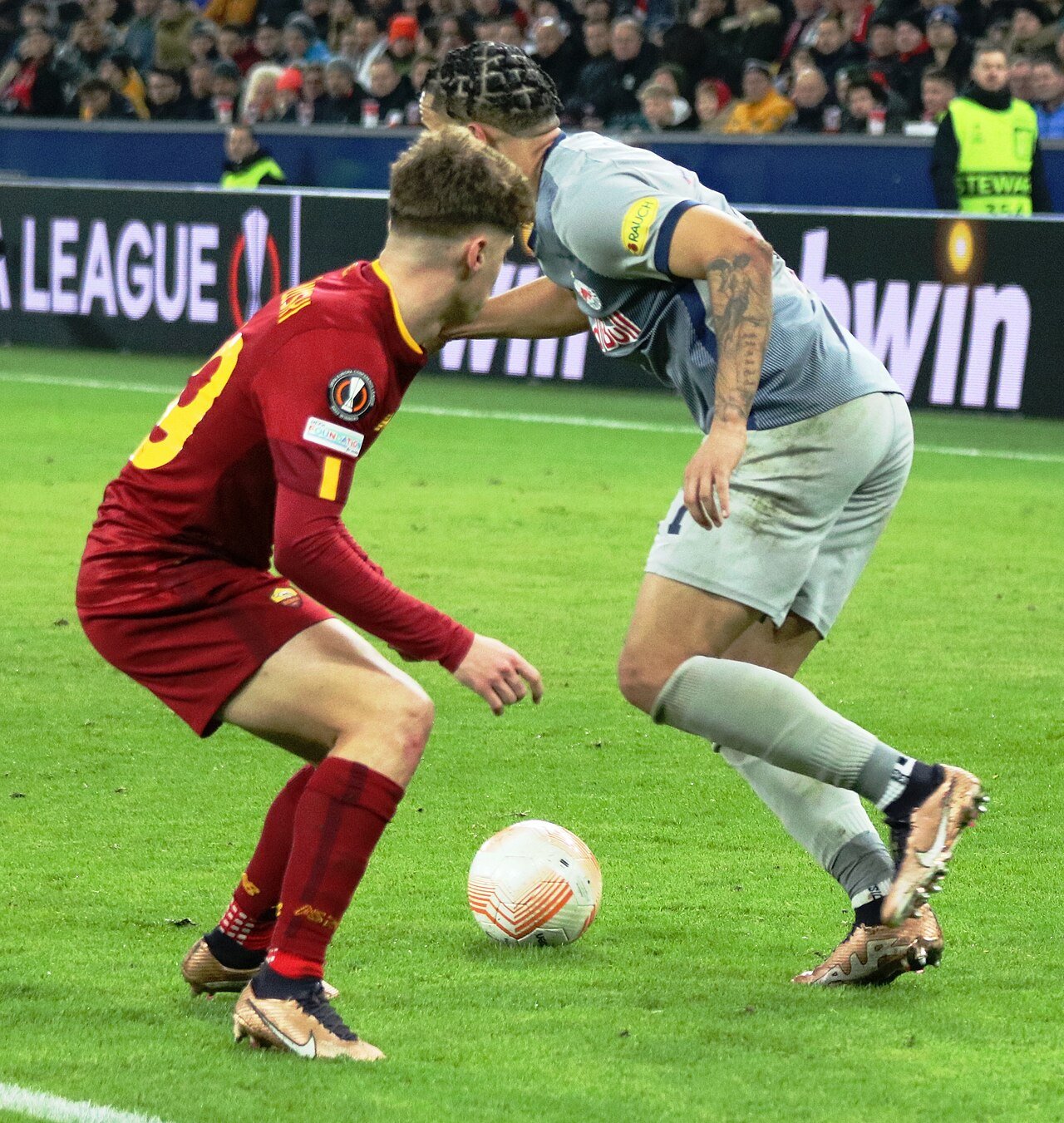
Archive photograph: Noah Okafor playing for Salzburg against Roma on 16 February 2023 (not Chelsea v Leeds). Werner100359 / Wikimedia Commons, CC BY-SA 4.0. Resized copy. Licence: https://creativecommons.org/licenses/by-sa/4.0/