FIFA has announced that its 2027 Football Law Annual Review will be held in Dubai on 18 and 19 February. The governing body published the announcement on Friday, 20 November 2026, and will organise the conference with the Asian Football Confederation and the United Arab Emirates Football Association. The agenda includes international transfers, transfer certificates, football agents and the FIFA Clearing House. For Indonesian clubs, the useful question is not who can travel to Dubai, but which parts of their own procedures need attention before the conference begins.
FIFA says the event will be conducted in English and streamed through its Legal website, with simultaneous interpretation in French and Spanish. It also plans to make audio and video recordings available afterwards. Those are the arrangements FIFA has announced, not evidence that an Indonesian club is attending, a place has been booked or an application has been accepted. The programme says the livestream is free and does not require advance registration. Its displayed times are Gulf Standard Time, three hours behind western Indonesian time (WIB). The first day’s opening is scheduled for 13.00 in Dubai, or 16.00 WIB. The conference is listed at The Westin Dubai Mina Seyahi. The programme lists 15 January as the deadline to express interest in attending in person, but submitting the form does not guarantee a seat.
The February dates should not be confused with the rules calendar. FIFA announced the revised Regulations on the Status and Transfer of Players in June 2026 and says the new edition enters into force on 1 January 2027. The Dubai meeting will discuss legal and regulatory matters after that date; it does not activate the new rules. Nor does every topic on the programme represent a new requirement. For an Indonesian club, a useful reading of the announcement starts with three separate files: a trial invitation, a registration history and a transfer agreement.
A trial invitation is not a transfer
Article 19ter addresses trials. Where the FIFA procedure applies, the club and invited player agree the terms, such as responsibility for travel, accommodation, meals and daily expenses, before the trial begins. The inviting club must lodge the completed, signed FIFA Trial Form in the Transfer Matching System, or TMS, at least ten days before the trial starts. A professional trying out at another club also needs express written permission from their current club. An email setting a training date does not replace either requirement.
That distinction matters on both sides of an invitation. If an Indonesian club invites a player under the applicable FIFA procedure, it should identify the person responsible for the form, the person checking the player’s current status and the person confirming the start date against the filing deadline. If an Indonesian club’s own professional player is invited abroad, the foreign host is responsible for lodging the form, while the home club needs to address the written permission. The respective responsibilities should be clear before tickets or accommodation are arranged, rather than discovered when the player arrives.
A trial does not register the player or make them eligible to play in official competition. The regulations limit participation during the trial to friendly matches and activities outside organised football. They also place a duty of care on the host club, including covering necessary treatment for injuries sustained during trial activities. Minors face additional age and safeguarding conditions. An academy should not assume that a parent’s approval alone settles eligibility; it should confirm the applicable requirements with the relevant association before promising a place or arranging travel. Immigration and welfare checks are separate from lodging the form.
The electronic player passport records registration history
The FIFA Clearing House will also feature in Dubai. FIFA describes the electronic player passport, or EPP, as a record of a player’s registration history from the age of 12. A provisional record can be generated in TMS; relevant clubs and associations can take part in its review before FIFA determines the final version. That record helps the system work out training rewards where a qualifying event gives rise to them. Age 12 is the starting point for the registration history in this process, not the age at which a child may undertake an international trial.
An academy’s attendance spreadsheet is valuable for coaches, but it is not the same as a registration record maintained through the football association. One practical job is to reconcile basic details: spelling of names, dates of birth, the FIFA ID where available, the club and the dates of formal registration. If an academy’s own records disagree with an association record, the relevant office should verify the discrepancy while supporting evidence is still available. Recording that a player attended training is not, by itself, proof of formal registration or a guarantee of a future payment.
Similarly, training rewards for a club and a player’s participation in a transfer fee are different questions. One concerns clubs involved in training and development; the other concerns what a player may receive because of their own transfer. Putting both under a single heading in a budget can hide the difference in who pays, who receives and what event triggers the obligation.
A transfer fee may raise a separate question for the player
The January 2027 regulations introduce Article 21bis on a player’s participation in a transfer fee. The mandatory provision is limited: it concerns permanent international transfers of players whose fixed annual remuneration with the releasing club in the transfer season is below EUR 150,000 or the equivalent. In cases covered by the provision, the releasing club must pay the player an amount equal to five per cent of the fixed transfer fee it actually receives. If that fee is paid in instalments, the regulation provides for proportionate payments after the relevant receipts.
That is not a five per cent rule for every transfer. The article addresses limited waivers and exceptions involving applicable national law, domestic provisions already in force at adoption and certain collective bargaining arrangements. A domestic move, a loan or a transfer without a fixed fee should not simply be put through the same calculation. Clubs and players may also agree on fee participation separately. Officials should check the applicable text and obtain case-specific advice rather than use a percentage from a summary as a substitute for reviewing a contract.
A useful first step before February is to allocate responsibility for the three files. The sporting staff can identify what is being proposed, the club’s registration lead can check records with the appropriate association, and the officials responsible for contracts and finance can identify the payment terms that need review. The Dubai livestream then becomes an opportunity to ask better questions about the distinctions that matter. The underlying work does not require an overseas trip: know whether the club is considering a trial, documenting a player’s history or negotiating a transfer, and apply the rules for that task rather than borrowing assumptions from the other two.
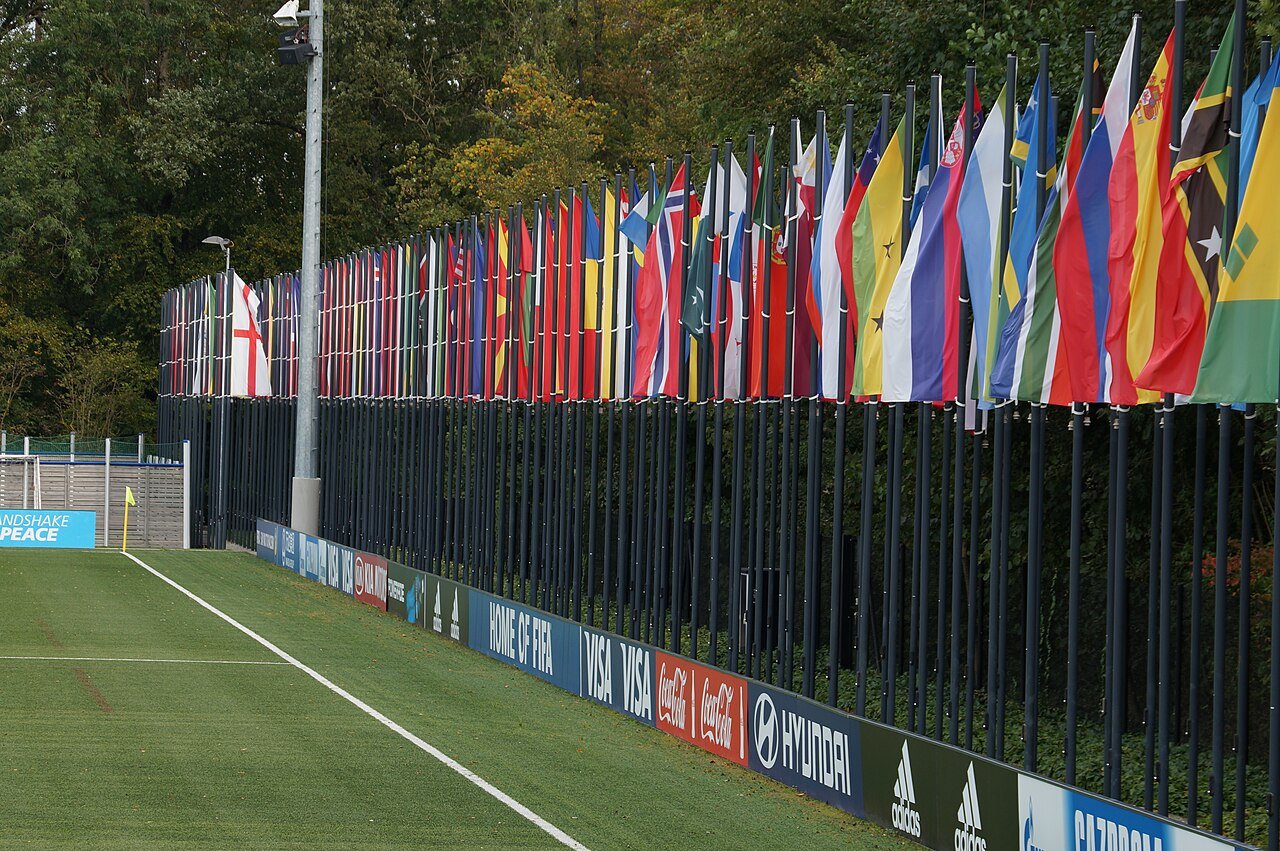
Archive photo: flags at FIFA headquarters in Zurich, 1 October 2016, not the Dubai venue. Albinfo / Wikimedia Commons, CC BY-SA 4.0. Reduced-size copy. Work URI: https://commons.wikimedia.org/wiki/File:Home_of_FIFA_-_flags.jpg. Licence URI: https://creativecommons.org/licenses/by-sa/4.0/.